What to Do If You Get Sick in Paris: GP, SOS, Urgent Care or Emergency Room?
Getting sick while travelling can be stressful, especially when you do not know how the French healthcare system works or where to find an English-speaking doctor in Paris.
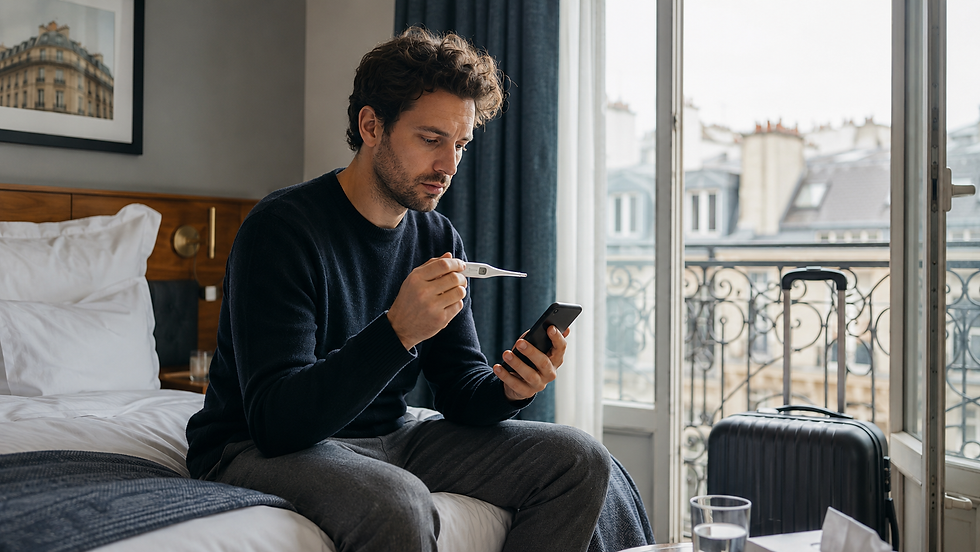
The short answer is simple: call 15 or 112 for a serious or potentially life-threatening emergency. For an urgent but stable medical problem, an appointment with a general practitioner (GP) is usually the most appropriate first step. A home-visiting doctor may be useful if you cannot travel safely, while a hospital emergency room should be reserved for conditions that may require immediate hospital treatment, monitoring, imaging or surgery.
This guide explains how to choose between a GP, an SOS or home-visiting doctor, urgent care and an emergency room in Paris.
Medical emergency: Call 15 for the French SAMU medical emergency service or 112, the European emergency number. Do not book an office appointment for severe chest pain, major breathing difficulty, signs of a stroke, loss of consciousness, a severe allergic reaction, uncontrolled bleeding, major trauma or any rapidly worsening condition.
Quick Answer: Who Should You Contact If You Are Sick in Paris?
See a GP for urgent but non-life-threatening symptoms
A French general practitioner, called a médecin généraliste, is usually the best first contact for a medical problem that needs prompt assessment but does not appear life-threatening.
A GP can examine you, prescribe medication available in France, provide medical documentation and decide whether you need laboratory tests, imaging, a specialist or hospital care.
Consider an SOS or home-visiting doctor if you cannot travel
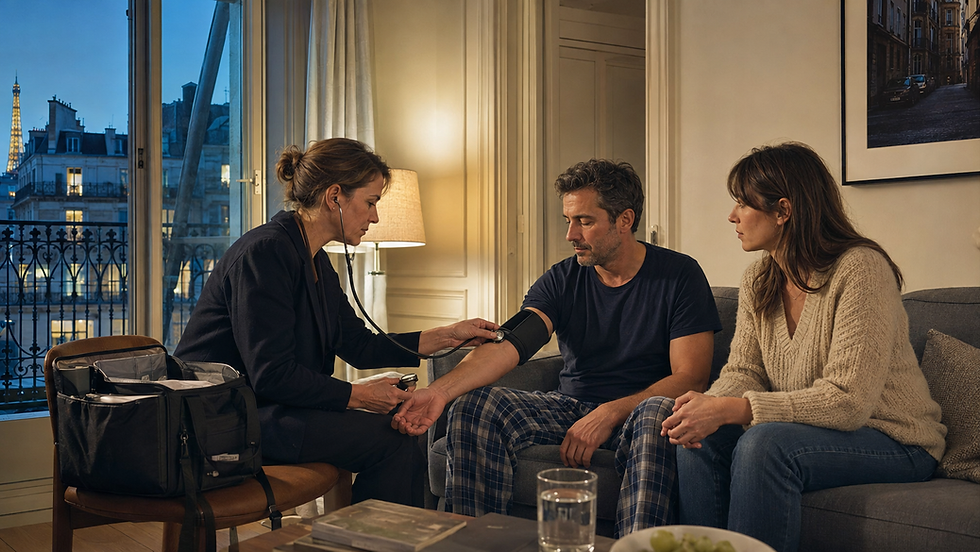
In France, the expression “SOS doctor” usually refers to an on-call or home-visiting medical service. A doctor may assess you at your hotel, apartment or place of residence, depending on availability.
This option may be appropriate when your condition is urgent but not life-threatening and travelling to a medical practice would be difficult. Waiting times and fees can vary. A home-visiting doctor is not an ambulance service and does not replace the SAMU: call 15 or 112 if the symptoms may be serious.
Understand what “urgent care” means in France
France does not have one uniform nationwide network of urgent care centres equivalent to the American model. Non-emergency same-day care may be provided by general practices, walk-in centres, maisons médicales de garde or specific hospital units. Opening hours, appointment rules and available tests differ from one facility to another.
If you are stable, an English-speaking GP in Paris can often provide the initial assessment and direct you to the correct service. If you cannot find appropriate nearby care or are unsure whether the situation requires a hospital, the French Ministry of Health advises calling 15 before going to the emergency department.

Go to an emergency room for serious or potentially serious symptoms
A hospital emergency department—les urgences in French—is appropriate when you may need immediate treatment, continuous monitoring, advanced imaging, emergency surgery or hospital admission.
Call 15 or 112 immediately for:
chest pain, severe shortness of breath or blue lips;
signs of stroke, such as facial weakness, arm weakness or sudden speech difficulty;
fainting with persistent symptoms, confusion or a seizure;
a severe allergic reaction, especially with swelling or breathing difficulty;
uncontrolled bleeding, major burns or serious trauma;
sudden severe abdominal pain;
suicidal thoughts with an immediate risk of self-harm;
any severe symptom in a baby, pregnant patient, older person or medically vulnerable patient.
When in doubt, call 15. The medical dispatcher will assess the situation and may provide advice, send an ambulance or direct you to the most appropriate service.
How the French Healthcare System Works for Visitors
The GP is usually the first point of medical care
In France, a GP manages most common illnesses and coordinates further care. A tourist does not need to have a French family doctor to request a consultation with another GP.
The GP may:
perform a clinical examination;
issue a French prescription;
recommend treatment and follow-up;
request blood tests or medical imaging;
write a medical report or travel-insurance document;
refer you to a specialist or emergency department when necessary.
Pharmacies can help, but they do not replace a medical consultation
Paris has many pharmacies, identified by an illuminated green cross. A pharmacist can advise on minor symptoms, provide certain non-prescription medicines and help you find an open pharmacy. However, many medicines require a French or otherwise valid prescription, and a pharmacist cannot replace a medical examination when symptoms are persistent, severe or unclear.
The French emergency numbers are 15 and 112
15 — SAMU: medical emergencies and urgent medical orientation.
112 — European emergency number: works throughout the European Union and can connect you with the appropriate emergency service.
114 — accessible emergency service: available by text and other accessible channels for people who are deaf, hard of hearing, deafblind or aphasic.
18 — Fire and Rescue Service: commonly used for accidents, fires and rescue situations.
Calls to the official emergency numbers are free. Be ready to provide your exact address, telephone number, symptoms, age and relevant medical history. If you do not speak French, say “English, please” and give your location slowly; immediate access to an English-speaking operator cannot be guaranteed.

Need an English-Speaking GP in Paris?
For a non-life-threatening medical problem, Dr Grégory Dacourt provides general medical consultations in English for tourists, expatriates and international patients at Doctors in Paris.
Appointments are available at two practice locations:
Paris 15: 4 Rue du Docteur Roux, 75015 Paris, near Pasteur metro station and Montparnasse;
Neuilly-sur-Seine: 39 Avenue du Roule, 92200 Neuilly-sur-Seine, convenient for western Paris, Porte Maillot and the La Défense area.
Same-day or short-notice appointments may be available depending on the schedule, including selected evening appointments. Video consultations may also be possible when clinically appropriate and when the patient is located in France.
What can be assessed at the practice?
The consultation may include assessment of common infections, fever, respiratory symptoms, ear problems, digestive symptoms, urinary symptoms, skin concerns, minor injuries and medication-related issues. Depending on the clinical situation, on-site examination can include tools such as an electrocardiogram, digital otoscopy or dermoscopy.
If hospital care is needed, Dr Dacourt can provide an appropriate referral and explain the next steps in English. Prescriptions, medical reports, invoices and supporting documents for travel insurers can also be provided when relevant.
Book an appointment with an English-speaking GP in ParisBook an appointment with an English-speaking GP in Neuilly-sur-Seine
Doctors in Paris is an appointment-based general medical service, not a hospital emergency department. For a life-threatening emergency, call 15 or 112 immediately.
How Much Does Medical Care Cost for a Tourist in Paris?
The French system differs from many international insurance systems. Visitors may be asked to pay for the consultation, medication, tests or hospital care and then request reimbursement from their insurer.
Bring, when available:
a passport or identity document;
your travel-insurance details;
your European Health Insurance Card (EHIC/CEAM) or UK GHIC, if applicable;
a list or photograph of your regular medicines;
details of allergies and major medical conditions;
recent medical reports or test results;
a payment method.
Keep every invoice, prescription, medical report and proof of payment. Reimbursement depends on your country of insurance and your policy. Travellers covered in the European Economic Area or Switzerland should consult the official information on the European Health Insurance Card and temporary care in France.

Frequently Asked Questions About Getting Sick in Paris
Can a tourist see a GP in Paris?
Yes. Tourists and international visitors can consult a GP in France without having a French médecin traitant. An appointment is usually required, and the visitor may need to pay directly before claiming reimbursement from travel insurance.
How do I find an English-speaking doctor in Paris?
Doctors in Paris provides consultations in English in Paris 15 and Neuilly-sur-Seine. Online booking shows the current availability for in-person and, when appropriate, video consultations.
Should I see a GP or go to the emergency room?
See a GP for urgent but stable problems such as a common infection, mild-to-moderate digestive symptoms, urinary symptoms, a non-severe rash or a minor injury. Call 15 or 112 for severe symptoms, rapid deterioration or any possible threat to life or limb.
Is SOS Médecins the same as an ambulance?
No. An SOS or home-visiting doctor provides medical assessment outside a practice when available. It does not replace the SAMU or an ambulance for a serious emergency.
Should I call 15 before going to an emergency room in Paris?
If you are unsure, cannot find appropriate nearby care or think the condition may be serious, call 15. A medical dispatcher can assess the urgency and direct you to the appropriate service. The French Ministry of Health specifically recommends calling 15 when no suitable local care option is available before travelling to an emergency department.
Can a doctor in Paris issue a prescription for medicine I lost while travelling?
A GP can review your medical history and, when medically appropriate and permitted in France, issue a prescription. Bring a photograph of the medication box, a previous prescription or a message from your usual doctor if possible. An identical brand or formulation may not be available in France.
Can I receive documents for my travel insurance?
Yes. When relevant, the consultation can be documented with an invoice, prescription and medical report. Reimbursement remains subject to the terms of your insurer and is not guaranteed by the doctor.

Comments